
By Kristi Stanbery-Bedgood, CEO & Managing Partner, Consult b3
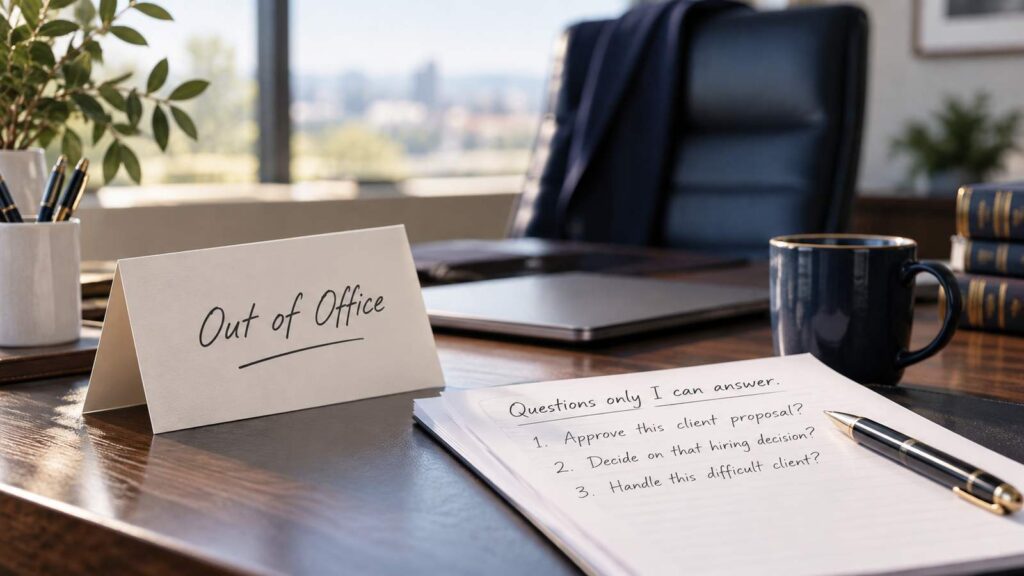
If work at your law firm stops, slows down or stacks up every time you step away, the firm can’t run without you yet. Three signs give it away: every decision routes back to you, the answers live only in your head, and time off costs you more than it gives back. None of this makes you a bad owner. It shows you where the firm keeps its know-how, and that’s something you can change.
For more than 30 years, I’ve helped businesses bridge the gap between strategy and execution, and I’ve watched this pattern show up in firm after firm. The owners are smart, capable people who built something that works. It works as long as they’re in the room.
What does it mean when a law firm is owner-dependent?
An owner-dependent law firm is one where certain decisions, answers or client relationships live with the owner and nowhere else. Take the owner out for two weeks and that part of the work waits until they’re back.
That’s different from an owner who’s busy. Plenty of owners carry a full caseload and still have a firm that keeps moving while they’re in trial or on a plane. The test is what happens to everyone else’s work when you can’t be reached.
Picture a managing partner who takes a week off in July. Nothing goes wrong and nobody calls, so she counts it as proof the firm runs fine without her.
Then Monday comes. New client inquiries sat unsigned because nobody else starts an engagement. Two fee questions waited for her. A hiring decision didn’t move. The firm made it through the week, but it paused until she got back.
What are the signs your law firm can’t run without you?
These are the three I look for first.
Sign 1: Every decision routes back to you
Your team checks with you on fee adjustments, which cases to take and whether a letter can go out. When routine decisions land on your desk, decision-making authority never left it. Your people are being careful, which is reasonable when nobody has told them where their authority starts and stops.
Sign 2: The answers live only in your head
Think about how your firm quotes a flat fee, what happens between a first call and a signed engagement letter, or what a good client update looks like. If the only correct version of those answers is the one you’d give, your team has one sensible option, which is to ask you. If it only works because of who’s doing it, it isn’t a process yet.
Sign 3: Time away costs more than it gives back
You know this one by the vacation where the phone never stops, the week off that takes three weeks to recover from, or the trip that quietly gets cancelled because the timing never works. When stepping away creates more work than it relieves, the firm is telling you how much of it still runs through you.
If you recognized all three, you’re in good company. It’s the most common pattern I see in law firms that grew faster than the way they’re run.
Why do good law firm owners end up here?
Owner dependence is rarely a personality problem. Owners tell me, “I know I need to let go, I can’t seem to stop being in everything,” and they say it like a confession. What I usually find is a storage problem.
You were there first. You knew the most. Answering was faster than explaining. Then the firm grew, and the answers never moved out of your head.
The time has to come from somewhere. Clio’s 2025 Legal Trends Report found that lawyers capture 3.0 billable hours in an average eight-hour day. That leaves five hours a day going somewhere else, and in the firms I’ve worked with, a large share of the owner’s five goes to answering questions nobody else can answer.
Is owner dependence a workload problem or a structure problem?
It’s a structure problem, which is good news, because structure can be built.
Most owners treat it as workload. They hire another associate or paralegal, and for a month it feels better. Then the new person starts bringing their questions to the same desk.
The chain looks like this. The work lives in your head. So every decision routes back to you. So the team waits instead of moving. So the day you step out, the firm slows down.
The Canadian Bar Association’s practice guidance on taking a vacation makes the same point from the other side: “The better the systems, the more efficient the law firm and the less dependent the practice is on the lawyer.” Systems are how answers get out of one head and into the firm.
How can you test whether your law firm runs without you?
Run a one-week question log. It costs nothing, and it shows you exactly where the firm leans on you.
- For five working days, write down every question that lands on you. Don’t change how you answer. Capture it and move on.
- At the end of the week, mark each one: only I can answer this, someone else could answer this if it were written down, or someone else already knew and asked anyway.
- Count the middle group.
The first group is real, and it’s usually short: strategy, a judgment call on a sensitive client, a key hire. The middle group is the long one, and it’s your map. Every question in it is a piece of the firm that lives in one head.
You don’t have to fix any of it yet. An honest count beats a rushed fix.
What should a law firm owner fix first?
Start with whatever everything else is sitting on. That’s the order behind the b3 Growth System™: 6 Foundations that stabilize how you run it. 8 Drivers that scale it further, until the business grows with or without you in the room.
Owner dependence is Foundation work. One of the six b3 Growth Foundations™ is The Playbook, which is the handful of things your firm has to get right every time, written down the way you want them done.
The usual instinct is to reach for a Driver instead: more marketing, another hire, new software. Drivers multiply whatever structure is already there. If every answer still lives with you, growth sends more questions to the same desk.
So pick one question from the middle group of your log. Write the answer on one page and hand it to the person who asks it most. Watch where they get stuck, because that’s where your next page starts.
I believe growth shouldn’t create chaos. A well-built law firm keeps moving when you’re in trial, on vacation or home for dinner on a Tuesday, and you build it one written answer at a time.
Frequently asked questions about owner-dependent law firms
How do I know if my law firm is too dependent on me?
Look at what happens to other people’s work when you can’t be reached. If decisions wait, routine questions pile up, or new clients don’t get signed until you’re back, the firm depends on you for more than legal judgment. A one-week log of every question you’re asked will show you how much.
How long should a law firm be able to run without its owner?
Two weeks, fully unreachable, is the test I use. A long weekend doesn’t tell you much, because most work can wait three days. Two weeks is long enough for new inquiries, billing and client updates to either keep moving or visibly stall.
Will hiring another lawyer fix owner dependence?
Usually not on its own. A new hire walks into the same structure, so their questions go to the same desk as everyone else’s. Write down how the work gets done and who decides what first, and the hire has something to stand on.
Want to know where your business actually stands?
The b3 Growth Readiness Assessment looks at your firm across the 6 Foundations and the 8 Drivers. It takes about five minutes and it’s free: https://assessment.consultb3.com
Consult b3 is a business development advisory coaching company, not a law firm. This article is general business information, not legal advice.
About the author
Kristi Stanbery-Bedgood is the CEO & Managing Partner of Consult b3, a business development advisory coaching company. For more than 30 years, she has helped businesses bridge the gap between strategy and execution. She has owned three service-based businesses and sold two. She is an ICF PCC Certified Coach and is Lean Six Sigma Black Belt certified.